Tuesday, June 25, 2013
Sunday, June 23, 2013
There is no legal requirement for suicide exemptions
This article appeared in the print edition of the Sunday Business Post on 23rd June 2013
Dr. Maria Cahill speaking to the Oireachtas Health Committee
Although the European Court of Human Rights specifically requested that Ireland provide legal clarity in relation to lawful medical treatments in pregnancy, the political rhetoric surrounding the introduction of the Protection of Life during Pregnancy Bill has been a model of legal obfuscation.
The government has been keen to emphasise that it is obliged to legislate to introduce abortion on the grounds of suicidal intent, and both the Taoiseach and the Minister for Health have, on countless occasions, presented this 'obligation' as deriving from law: from the Constitution or from the European Court of Human Rights or from the Supreme Court.
So long as this political rhetoric around legal obligation holds sway, frank debate about the terms and merits of the legislation is almost impossible. Indeed so long as this political rhetoric is unchallenged, there is no necessity for the minister to present the legislation as medically justifiable and legally legitimate; he can simply say that he has no choice.
Is the government constitutionally obliged to legislate for a Supreme Court judgment? No, as a matter of law. The Constitution gives permission to the Dáil and the Seanad to legislate, rather than imposing such an obligation on them. There are examples dating all the way back to 1965 of the Court establishing that various rights exist, only to have fourteen successive governments decline, in the lawful exercise of their discretion, to legislate to provide an express statutory footing for these rights. The only constitutional obligation is that legislation must remain within the terms of the Constitution. In this instance, the right to life protected in Article 40.3.3 must be fully vindicated.
Is the government legally obliged to legislate for a suicide-based exemption from the right to life because of the European Court of Human Rights ruling in the case of ABC v Ireland? No, as a matter of law. The Rules of the Committee of Ministers require that Ireland should adopt measures that are "effective for preventing the recurrence" of the breach that was found in the case of ABC v. Ireland. Applicant C, following an internet search, diagnosed that her cancer might return during her pregnancy, and then went to England to have an abortion. She was not suicidal. A suicide-based exemption from the right to life would not have clarified her legal position at all.
Aside from the fact that the Oireachtas is under no constitutional obligation to legislate for the X case, is a future court bound by that precedent to allow suicide-based exemptions from the right to life? No, as a matter of law. The X case is in a separate category of judicial decisions because of what it did not decide. As every first year law student learns, a precedent is only binding in relation to the points that were decided in the case.
All the points that were "entirely overlooked or conceded without argument" are not part of the decision, as the Supreme Court itself ruled in 1965. If a point is not argued before the judge, the judge cannot make a decision on that point, and there is therefore no precedent on that point. If it were to be otherwise — if precedents could be made based on what the judges did not decide in court — then we would not be living under the rule of law.
In the X case, the Attorney General did not contest whether abortion was an appropriate treatment for suicidality. That is why neither the High Court nor the Supreme Court heard any legal arguments or medical evidence on the question of whether suicidality should be treated by abortion. The point was entirely overlooked or conceded without argument and therefore, according to the Supreme Court, no precedent exists on that point.
Is the X case the most recent legal decision in the area of suicide-based exemptions from law? No, as a matter of law. In 2006, the Cosma case concerned a woman who threatened to commit suicide if she were deported. The High Court based its ruling on the test of "real and substantial risk" determined in the X case, but developed that test in important ways.
First, it required that the risk should be demonstrated in the context of an ongoing psychiatric relationship where the patient would receive counselling and all psychiatric treatment that she needed. Second, it held that she should demonstrate that all other avenues for treating her suicidality should have been thoroughly considered before concluding that revoking the deportation order was necessary.
Moreover, the Court ruled that the Minister for Justice was entitled to take into account the floodgates argument and to refuse to quash the deportation order because other people might abuse a suicide-based exemption. The minister had argued that allowing suicide-based exemptions would open "a Pandora's box" with the effect of "paralysing" the operation of the rule of law in general.
The concept of suicide-based exemptions from law is a new one in the Irish legal system and it warrants careful consideration. There are many cases, like the Cosma case, where people have presented psychiatric evidence regarding their suicidal ideation because of a deportation order or a European Arrest Warrant; should they now be granted exemptions by the courts?
There are also many unfortunate instances of Irish people who are suicidal because of crippling financial constraints; should they also be granted suicide-based exemptions from making mortgage repayments or paying taxes? Before embarking on this entirely novel approach to legislative obligation, shouldn't we ask the question whether there is psychiatric evidence supporting suicide-based exemptions from law as an effective way of treating suicidality?
The legal reality is that there is no obligation on the Government deriving from the Constitution or from the European Court of Human Rights or from the Supreme Court to propose legislation for a suicide-based exemption from the right to life.
When we hold to that legal reality then we can begin to debate the real question: is it just to propose that the right to life of one person can be denied if another threatens to commit suicide due to the very existence of that first person? This is the question that should be discussed in Dáil Éireann this week.
Dr Maria Cahill is a Lecturer in Constitutional Law in University College Cork and was invited by the Oireachtas Health Committee to give evidence at the hearings on the Heads of Bill in May.
by Dr. Maria Cahill, Faculty of Law, UCC
www.prolifecampaign.ie
Thursday, June 20, 2013
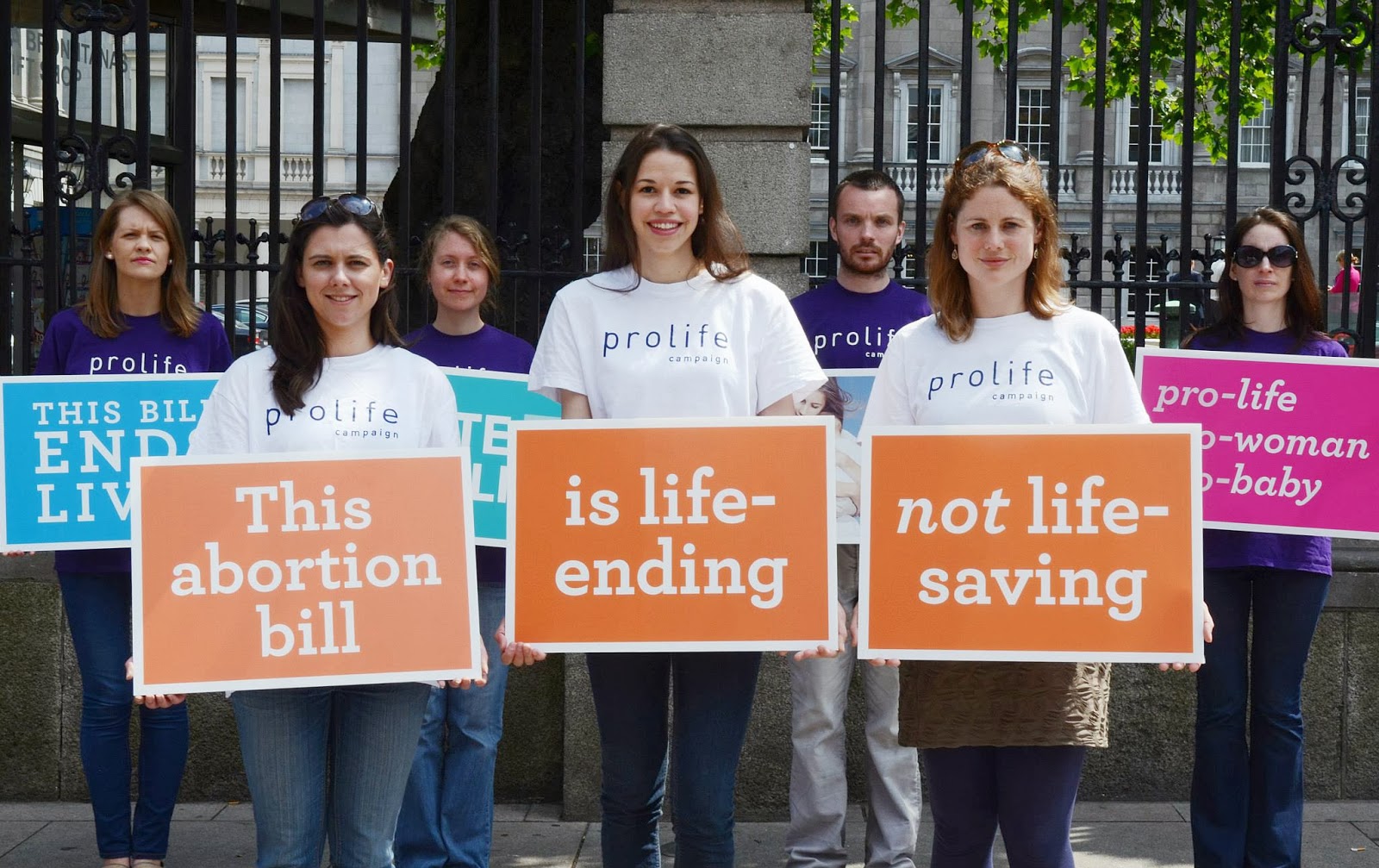
Abortion - life saving?
PLC says it’s “dishonest” for Government to claim that abortion in the case of threatened suicide is life saving when it is life ending
“Minister Reilly’s admission that more babies will be born with severe disabilities if Bill is passed highlights obscene nature of the proposal” – Sherlock
The Pro Life campaign has described as “shamelessly dishonest” the claim by the Government that providing abortion in the case of threatened suicide is life saving, when it is life ending. Commenting on the introduction of the abortion Bill before the Dáil today, Cora Sherlock of the Pro Life Campaign said: “It is time to end the deception. The Government knows full well from the evidence at two separate Oireachtas hearings that abortion is not a treatment for suicidal ideation. Trying to claim otherwise is dishonest.”
“If the Government genuinely wants to improve healthcare for women and unborn babies, it should admit that it has not a shred of psychiatric or medical evidence to support its position.”
Ms Sherlock said: “Minister Reilly’s admission earlier this week that more babies will be born with severe disabilities if the Bill is passed highlights the obscene nature of the proposal. When introducing the Bill today, there will be a lot of talk from the Government benches about it being a ‘restrictive’ and ‘life saving’ proposal. In truth, many of those who will defend the Bill know this is not the case.
"It is a sad day for our country. However, the pro-life movement is re-energised and growing like never before and we will stay focussed for however long it takes in building the opposition to the Government’s dangerous and unjust plan.”, Ms Sherlock concluded.
Below are some pictures of Pro Life Campaign volunteers at Dáil Eireann on 20th June, the day the abortion legislation was introduced into the Dáil
A message from Caroline Simons at this important time
Dear Friend,
Many members of the Oireachtas are refusing to engage in meaningful discussion on what the Government’s proposal entails. It is very troubling to see TDs pressurised by party handlers and the party whip to vote for abortion.
People are rightly offended when Government spokespersons distract from the abortion bill by focusing on the unacceptable behaviour of a tiny minority (whose allegience is unknown) in order to demonise the whole pro-life movement.
We all know that the overwhelming majority of pro-life people debate this issue in a calm, courteous and responsible manner. As Labour TD Joanna Tuffy tweeted recently, “the vast majority of correspondence from my pro-life constituents is respectful” and that pro-life people were “just putting their viewpoints across.”
There is always a tiny minority of individuals who behave inappropriately. When someone on the pro-life side does so, we must not hesitate to name it and make it clear that such behaviour is wrong and counterproductive. But we cannot allow it to distract from the main issues in the debate.
In recent weeks the Pro Life Campaign and some of the other pro-life groups have received vile and disturbing threats on phone, email and social media. But rather than run to the media, we reported them to the Gardaí. Instead of drip feeding stories to the media in an attempt to damage the pro-life movement, it would be more appropriate for members of government to similarly report any threatening incidents to the Gardai.
No question, this is a challenging time for us all. But I'm sure you'll agree that it’s also a privilege to be part of such a noble cause. Together, we are playing a vital role in building a culture of respect for the dignity of human life from conception to natural death.
The Government may well think the pro-life groundswell evident today will die away in a month or so when they turn their attention to other government business. As the pro-life vigils have shown, that’s not going to happen. For us, it will just be a beginning.
There will be plenty of time after this phase of the campaign to expose the lies and misrepresentation that has gone on.
But for now, we need to stay focussed on the task at hand. Let's continue to do all we can to urge our politicians to consider the real implications of this terrible Bill and encourage as many as possible to vote against it.
And let's encourage everyone we know to stay positive and do the cause proud.
Thank you for your prayers and continued support.
Caroline Simons
Pro Life Campaign
Pro Life Campaign
Wednesday, June 19, 2013
Press Conference by the Pro Life Campaign
Life-and-death issues deserve a free vote – Pro Life Campaign
“Travesty for the Taoiseach to demonise the pro-life community as a whole by focussing on the unacceptable behaviour of a tiny minority” – Simons
Geraldine Martin, Professor William Binchy, Caroline Simons, Dr. Berry Kiely, Seana Stafford
Speaking at a PLC Press Conference at Buswells Hotel, Dublin today, Caroline Simons said: "The Protection of Life During Pregnancy Bill is causing unprecedented concern throughout the country and ordinary citizens cannot understand why their views are not being represented in Dáil Éireann.
“There is a real danger to our democracy if people are prevented from voting according to their consciences on life-and-death issues. Political parties in other countries, including Britain, don’t have a problem with a free vote on crucial issues. The sky doesn’t fall. In fact, democracy is strengthened because the full range of viewpoints is properly represented as a result,” Ms Simons said.
“It’s true that Irish political parties by and large have not followed this tradition, but we’ve never had legislation like the ‘Protection of Life during Pregnancy Bill’ before. This legislation permits the direct killing of unborn children even into the late stages of pregnancy. Not only that the suicide ground hasn’t a shred of medical evidence to support it. This is an appalling indictment of the Government’s proposal.”
Addressing the suggestion that a free vote would result in politicians coming under excessive pressure or intimidation, Ms Simons said:
“Either we trust the electorate or we don’t. While there are always fringe elements on any issue the majority of people can be trusted to engage in responsible political discussion with their TDs and with those who disagree with them. It is a travesty for the Taoiseach to demonise the pro-life community as a whole by focussing on the unacceptable behaviour of a tiny minority whose allegiance in any case is unknown.
“In the context of a free vote, the Pro Life Campaign, and I’ve no doubt, the other main pro-life groups, would call out and challenge unacceptable behaviour. I would expect the pro-choice side to do the same.”
“This is a defining week in our history," Ms Simons said, "as legislation comes before the Dáil allowing abortion to be introduced. It is unthinkable that members of the Oireachtas would be forced to vote against their consciences on this life and death issue.”
www.prolifecampaign.ie

Monday, June 17, 2013
Decision to oppose the Abortion Bill
Senator Fidelma Healy Eames’ decision to oppose the Government’s abortion Bill is “courageous and compassionate”
In a statement welcoming Senator Healy Eames’ decision to vote against the Government on the proposed abortion legislation, PLC spokesperson Cora Sherlock said that the personal sacrifice of losing the backing of one’s party “was not one that should be underestimated”.
“No-one should be under the impression that it is easy for a politician to step outside the party they have been a part of for a long time."
It is particularly hard for a Senator, who relies on the votes of County Councillors from across his or her party to get elected. The irony of the situation is that Senator Healy Eames is losing the party whip for standing by a specific pledge made by her own party at the last General Election.
“As she said in her own statement, there are many in Fine Gael who are disappointed that the party is breaking its pre-election, pro-life promise.”
Senator Healy Eames made it clear in her statement that while she was opposing the legislation she is fully supportive of medical interventions to save a woman’s life in pregnancy. However she also said that she could not support “a bill that will make it legal to intentionally destroy unborn human life where there isn’t a shred of medical evidence to justify it”.
The Senator's announcement comes just days after a similar statement from Deputy Peadar Toibín of Sinn Féin.
“Senator Healy Eames and others are taking this stance because they has looked at the evidence. It is to be hoped that this example will be followed by many other TDs and Senators before the Bill is voted on", Ms. Sherlock concluded.
www.prolifecampaign.ie
Friday, June 14, 2013
Completely misleading for Sinn Féin leader
“Completely misleading for Sinn Féin leader to claim X Case legislation is necessary to save women’s lives”, says Dr Cullen
“Abortion is not a treatment for suicidal feelings”
Deputy Peadar Toibín TD
The Pro Life Campaign has described as “completely misleading” claims by Sinn Féin party leader Gerry Adams that the Government "needs to legislate in line with the X Case to protect pregnant women when their lives are at risk". Mr Adams was responding to the news that Sinn Féin TD Peadar Tóbín plans to vote against the legislation.
Dr Ruth Cullen of the Pro Life Campaign said: “The Sinn Féin leader knows full well that legislating for the X case includes abortion on the ground of threatened suicide, even though all the psychiatric evidence shows that abortion is not a treatment for suicidal feelings. If Mr Adams paid any attention to the recent Oireachtas hearings, he would also be aware that far from treating mental health problems, abortion can trigger severe adverse mental health consequences for women. It is completely misleading therefore for Mr Adams to claim that X Case legislation is necessary to save women’s lives.”
“Instead of coercing its TDs to vote for this dangerous and unjust legislation which will allow for the first time in our history the direct intentional targeting of the life of the unborn, the Sinn Féin Party, like the other political parties, should respect the freedom of conscience of its Oireachtas members and allow a free vote on the issue.”
www.prolifecampaign.ie
Subscribe to:
Posts (Atom)